
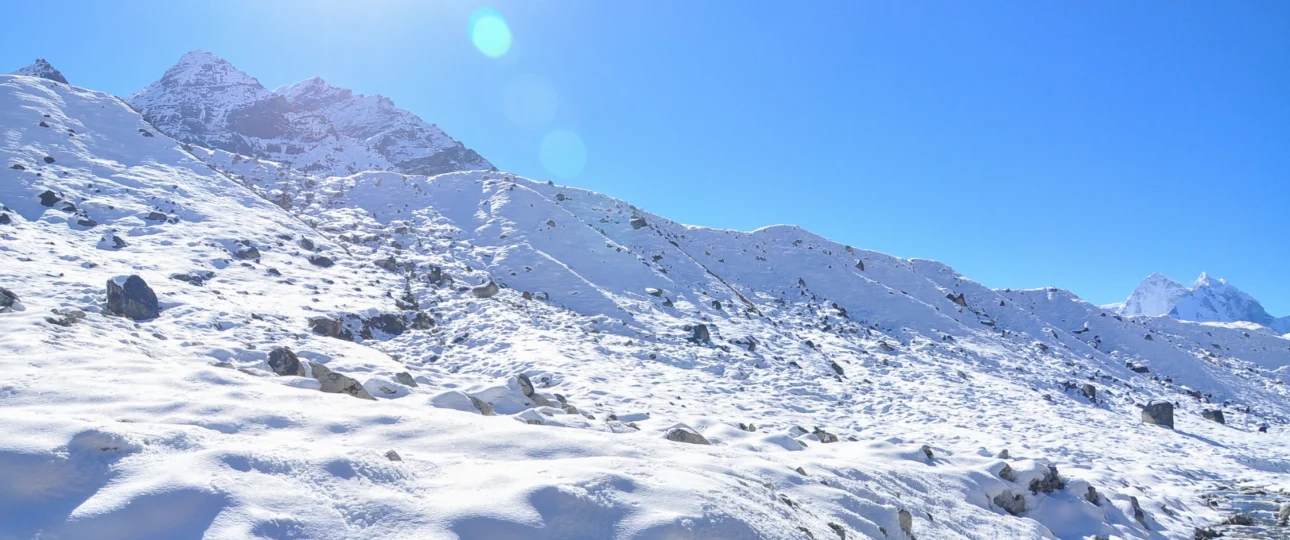
Island Peak, known locally as Imja Tse, gained immense fame as one of Nepal’s most-climbed high-altitude peaks, and for good reason. At 6,189 meters (20,305 feet), it gives climbers a real taste of Himalayan mountaineering without dragging them into the technical extremes that define the bigger expedition peaks.
So, how difficult is Island Peak climbing? The answer depends on your preparation, acclimatization, fitness level, and climbing experience. If you are a well-prepared trekker with excellent endurance and proper guidance, you will find Island Peak climbing to be manageable.
Island Peak is an achievable first 6,000-meter summit. However, the altitude, unpredictable Himalayan weather, and demanding summit day make it a serious adventure that requires respect and preparation.
Tucked into the Khumbu region inside Everest (Sagarmatha) National Park, Island Peak sits near the village of Chhukung and rewards climbers with views that are nearly impossible to beat anywhere else on earth. The south face of Lhotse looms overhead, Makalu in the distance, and Baruntse cutting a jagged line against the sky.
It combines high-altitude trekking with real mountaineering challenges, including glacier travel, fixed-rope climbing, steep ice sections, and an exposed summit ridge.
The name itself comes from early explorers who looked up from the valley floor and thought the mountain looked like an island rising out of a sea of ice and moraine. Sherpas call it Imja Tse, and it carries real cultural weight in the region, not just fame among foreign climbers.
The Nepal Mountaineering Association classifies Island Peak as a Group B trekking peak. That label makes it sound casual, but don’t let it fool you; you’ll still need permits, technical gear, and a guide who knows what they’re doing. It’s accessible, not simple.
Most people climb it as an add-on to the Everest Base Camp trek, though plenty attempt it as a standalone objective. Either way, it’s become something of a rite of passage: a mountain that tests your fitness and your acclimatization and your nerve, then hands you one of the best views in Nepal as a reward.
In this guide, we’ll break down everything you need to know about Island Peak climbing difficulty, including technical sections, fitness requirements, altitude challenges, preparation tips, success factors, and how Island Peak compares with other Himalayan peaks.
Table of Contents
Why People Actually Struggle on Island Peak

Here’s the thing about Island Peak: it’s rarely the technical climbing that breaks people. It’s everything else stacked on top of each other: the altitude, the glacier crossing, the weather, and the sheer physical grind of summit day.
Altitude is the primary challenge, and the numbers make it clear why. At the summit, oxygen levels are about 45–50% of sea level, so every step, breath, and decision costs more than at home. Above 5,000 meters, oxygen levels generally drop enough that every step costs more than it should. Summit day alone typically runs 10 to 12 hours of sustained exertion (some parties take up to 14 hours), starting with a pre-dawn departure from High Camp at 1:00 or 2:00 a.m., which is a long time to ask your body to keep performing at that altitude.
Along the way, you’ll transition through genuinely different kinds of terrain in a single push: a rock scramble up from High Camp, a glacier crossing roped together with your team while watching for hidden crevasses, and then a headwall where you’re climbing fixed ropes up steep snow and ice. After that comes a narrow, exposed summit ridge that demands real balance and a clear head, even when you’re exhausted.
Add in temperatures that regularly drop to between -15°C and -25°C on summit night, winds strong enough to cut visibility to nothing, and the simple fatigue of days of consecutive trekking before you even reach the climb, and you start to understand why so many climbers say the mountain wore them down more than they out-climbed it.
The technical moves can be learned in just a few days of training. Staying sharp through ten-plus hours of cold, thin air, and darkness is a different kind of challenge entirely.
Why Some Climbers Don’t Make the Summit
Turning back on Island Peak usually has little to do with climbing skill. It’s almost always altitude, weather, or a preparation gap that catches up with someone. Climbers who move too fast through the acclimatization schedule often start showing symptoms of AMS, headaches, and dizziness and have to descend before they even reach High Camp.
Others simply aren’t fit enough for a summit day this long, or they run into gear that doesn’t fit right, or they’ve never actually practiced with a jumar or crampons before the moment they need them under pressure.
Weather alone ends many attempts. High winds near the ridge are probably the single most common reason a guide calls off a summit push, not because the client can’t handle it, but because it genuinely isn’t safe.
Dehydration and poor eating over multiple days sap the energy people need for the final push. And occasionally it just comes down to a skilled guide making the right call to turn a team around rather than push into worsening conditions. Overall, poor acclimatization or lack of technical skill accounts for a large share of turnbacks, which is why guides put so much emphasis on both before anyone gets near summit day.
Climbers who do best are the ones who don’t rush: gradual acclimatization, solid fitness heading in, proper gear, and a guide team with real experience on this specific mountain during the spring or autumn windows.
Is This a Beginner’s Mountain?
Genuinely, yes, with the right preparation. Island Peak has become one of Nepal’s classic “first big mountain” objectives. You don’t need prior technical climbing experience walking in, though it helps. What matters more is showing up fit, trainable, and willing to take instruction seriously.
Before you go, work on cardiovascular endurance and leg strength, and get comfortable with the basics: walking in crampons, using an ice axe, ascending a fixed line with a jumar, and rappelling (typically with a figure-eight descender). Most operators run a short training session near Base Camp before the summit attempt, but arriving with some familiarity already built in makes a real difference.
Island Peak Difficulty Level
Officially, Island Peak sits at Alpine Grade PD+ (Peu Difficile Plus, “slightly difficult”) and NMA Group B, a semi-technical rating that puts it within reach of a strong, well-prepared beginner.
Under the International French Adjectival System, it’s typically rated IFAS II, which places it a notch above a straightforward snow walk like Mera Peak but well below a technical objective like Ama Dablam.
The “trekking peak” label undersells it a bit; you’re still dealing with glacier travel and fixed-rope sections that require real skill, just not the kind of technical climbing you’d find on a full expedition peak.
The technical crux of the whole route is the headwall: a 100–200 meter stretch of 45–60 degree snow and ice, climbed on fixed ropes with a jumar. It’s short compared to the overall summit day, but it’s where fitness, technique, and nerve all get tested at once, right before the exposed summit ridge.
Physical and Mental Side of It
Climbing to 6,189 meters asks a lot of your body, and honestly, just as much of your head.
Fitness: You need better-than-average endurance and legs that can carry you 6 to 8 hours a day with a 15–20 lb daypack over steep trails, rocky terrain, and glacier crossings day after day. People who’ve done high-altitude trekking before tend to handle this part more comfortably.
Training: Give yourself 4 to 6 months if you can. Stair climbing with a loaded pack, hill repeats, running or cycling for cardio base, and strength work for your legs and core all pay off. If you have access to elevation for training hikes, use it; otherwise, loaded hikes on hilly terrain will get you most of the way there.
Mindset: This is where many people underestimate the mountain. You’re pushing through cold, fatigue, and darkness on a pre-dawn summit push over exposed terrain, needing to stay committed even when everything in you wants to stop. The narrow summit ridge, with real drop-offs on both sides, is as much a psychological test as a physical one. Trust in your guide team and your ability to keep moving through discomfort tend to matter as much as raw fitness.
Acclimatization: This process is non-negotiable. The altitude gain from the valley up to Base Camp and High Camp happens fast, and rushing it is the single biggest risk factor for AMS.
The strongest itineraries build in a full Everest Base Camp trek approach, or at minimum a few extra nights around Namche and Dingboche, before ever heading toward Chhukung and Island Peak. A well-paced schedule with proper rest days, possibly supported by medication under a doctor’s guidance, makes the difference between a safe climb and a dangerous one.
Route Details: What the Climb Actually Looks Like
Breaking the Island Peak route down stage by stage helps explain where the difficulty really sits:
- Base Camp (around 5,100 m) to High Camp (around 5,600 m): A trek over rock and scree, gaining altitude steadily before the technical climbing even starts.
- High Camp to “Crampon Point”: A rock scramble in the dark, usually the first stretch of the pre-dawn summit push, before the terrain transitions to snow and ice.
- The Glacier Crossing: Roped travel across the Imja Glacier, navigating around or across crevasses; on some routes and in some seasons, the process involves short ladder crossings, similar in spirit to what’s used in the Khumbu Icefall, though far less exposed.
- The Headwall: The technical crux involves fixed ropes on 45–60 degree snow and ice for roughly 100–200 meters, which are climbed using a jummar.
- The Summit Ridge: A narrow, exposed finish above the headwall, demanding careful footwork and a clear head after hours of exertion.
What the Numbers Actually Say
Summit success sits somewhere between 60% and 70% overall, but that number moves a lot depending on how you climb. Fully supported commercial expeditions during prime season land in the 75–90% range. Rushed itineraries or independent attempts, on the other hand, can drop as low as 30–50%. Where the overall estimate falls short, it’s most often poor acclimatization or a lack of technical skill dragging the number down.
The season matters enormously here too. Autumn, especially October into early November, tends to produce the best odds, 80–90%, thanks to stable skies and firm snow. Spring runs close behind at 75–85%. Winter and monsoon attempts fall off a cliff, often below 25%.
When people do turn back, it’s usually one of three things: poor acclimatization or AMS (35–40% of failed attempts), exhaustion or fear on the steep headwall (34%), or high winds on the exposed summit ridge (25–30%). Despite all that, Island Peak has a genuinely strong safety record; the historic fatality rate sits well under 1%, which is part of why it’s such a popular proving ground for newer mountaineers.
What You Should Bring to the Table
You don’t need a climbing résumé to attempt Island Peak, but a few things will significantly improve your chances: solid cardiovascular fitness, ideally some experience trekking above 4,000–5,000 meters already, and the stamina to hike 6–8 hours a day for several days in a row.
You’ll want a working knowledge of crampons, ice axes, harnesses, and fixed-rope techniques, including basic jumar (ascender) use and figure-eight abseiling.
Most operators teach these skills on-site before the climb, so you don’t need to arrive as an expert. What you do need is confidence on steep, icy, exposed terrain; the mental toughness to push through cold and fatigue; and a willingness to actually listen to your guide when conditions call for a change of plan.
The Real Risks
Island Peak isn’t among the Himalaya’s most dangerous mountains, but it isn’t risk-free either. Altitude sickness, AMS, and, in more serious cases, HAPE or HACE are the most common problems climbers face, and proper pacing, hydration, and sometimes Diamox are the best ways to manage them.
Beyond that, there’s real objective danger on the glacier from hidden crevasses (occasionally crossed by ladder in tricky spots), exposure on the headwall and ridge, and the occasional avalanche risk. Weather can turn fast, sudden whiteouts can complicate navigation, and fatigue, snow blindness, and sunburn from intense UV at altitude are all things climbers deal with regularly.
The fatality rate stays low compared to the 8,000-meter giants, but it climbs sharply for people who skip licensed guides or show up underprepared. Climb with experienced local guides, carry real travel insurance, monitor the weather closely, and be ready to turn back if conditions aren’t right.
How It Stacks Up Against Other Peaks
| Peak | Difficulty | Technical Level | Compared to Island Peak |
| Island Peak (6,189 m) | Moderate to Challenging | Moderate — fixed ropes, glacier travel | A first technical Himalayan climb |
| Mera Peak (6,476 m) | Moderate | Low to Moderate | A first 6,000 m summit, less technical |
| Lobuche East (6,119 m) | Challenging | Moderate to High | Climbers wanting something more technical |
| Everest Base Camp Trek (5,364 m) | Moderate | Non-technical | High-altitude trekking, no climbing |
If you want your first real taste of technical Himalayan climbing, glacier travel, fixed ropes, and snow work, Island Peak is the obvious choice. If height matters more to you than technicality, Mera Peak gets you higher with less technical demand.
Already have some mountaineering experience and want a bigger challenge? Lobuche East delivers that. And if you’d rather skip technical climbing altogether while still experiencing the Everest region, the Base Camp trek is the better fit.
Frequently Asked Questions About Island Peak Climbing Difficulty
1. Is Island Peak harder than the Everest Base Camp Trek?
Yes, noticeably. EBC is a long, high-altitude trek, but Island Peak adds glacier travel, fixed-rope climbing, crampon and ice axe work, and a demanding summit push on top of that. It asks more of you physically and technically.
2. Can beginners actually climb it?
Yes. It’s one of Nepal’s classic introductory mountaineering peaks. Prior climbing experience helps, but it isn’t required; most first-timers succeed after basic training and guided support.
3. How technical is it, really?
It’s graded PD/PD+ under the Alpine system (roughly IFAS II) and is moderately technical. You’ll need working knowledge of crampons, ice axes, harnesses, jumars, and fixed ropes, with the headwall, a 100–200 meter stretch of 45–60 degree ice and snow, being the most technical stretch of the whole climb.
4. Is it dangerous?
Like any high-altitude peak, it carries real risk of altitude sickness, crevasses, steep ice, cold, and shifting weather, chief among them. With proper acclimatization, experienced guides, and the right gear, though, it’s considered one of the safer 6,000-meter objectives in Nepal.
5. How long does summit day take?
Most teams leave High Camp between midnight and 2 a.m., with the round trip running 8 to 14 hours (commonly cited as 10–12 hours) depending on conditions and pace.
6. What’s the actual success rate?
Well-run guided expeditions in peak season typically see 75–90% summit success, largely driven by acclimatization, fitness, and weather; the broader average across all attempt types is closer to 60–70%.
7. How cold does it get?
Summit-night temperatures typically range from -15°C to -25°C, and wind chill can make it feel considerably worse. Proper layering and insulated boots aren’t optional.
8. Do I need prior climbing experience?
Not strictly, but at least one high-altitude trek beforehand is a good idea. You’ll need to be comfortable with multi-day hiking and willing to learn the technical basics, including crampon use, jumaring ascent, and abseiling, before the summit attempt.
9. Is it harder than Mera Peak?
Technically, yes, the glacier travel, fixed ropes, headwall, and exposed ridge make Island Peak more demanding in that sense. Mera Peak is higher and more physically taxing because of the altitude and longer approach, but less technical overall. Which one’s “harder” really depends on whether altitude or technical climbing is your bigger concern.
Is Island Peak Climbing Right for You?
Island Peak is a challenging yet achievable 6,189-meter Himalayan climb. It offers the perfect introduction to high-altitude mountaineering. It is ideal for fit trekkers who are ready to learn basic climbing skills, adapt to high altitude, and embrace the challenges of glacier travel, fixed ropes, and a demanding summit day.
With proper training, gradual acclimatization, the right equipment, and experienced guides, Island Peak can become a rewarding first Himalayan summit experience. If you are ready to challenge yourself and stand above the Khumbu Valley, Island Peak is a climb worth considering.