
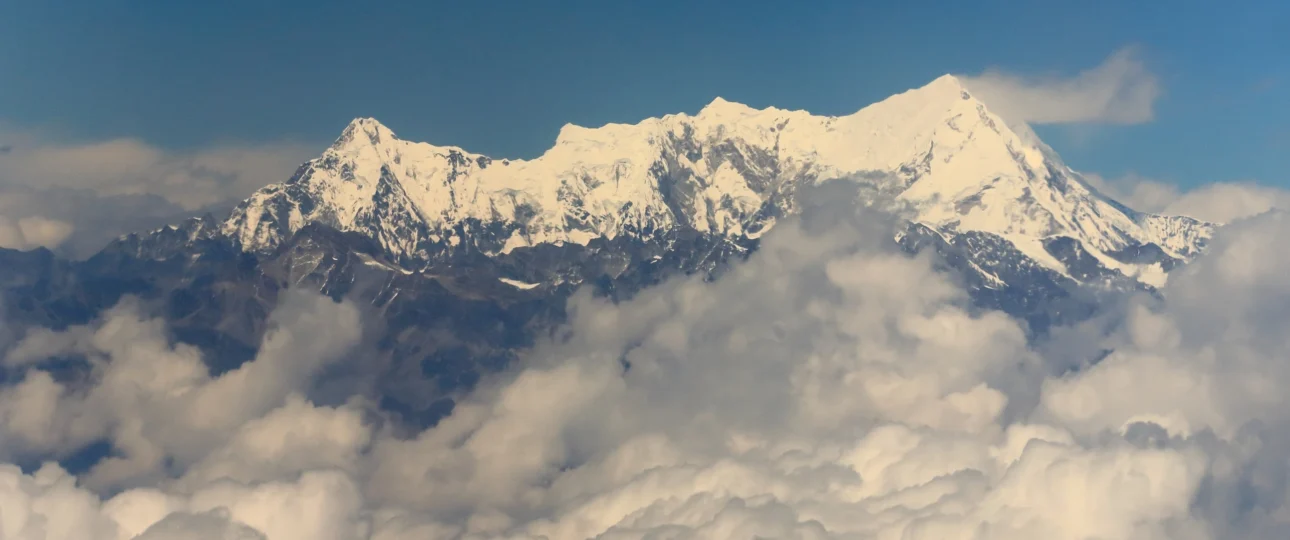
Island Peak Highlights
Island Peak, known officially as Imja Tse, rises to 6,189 meters (20,305 feet) in the Khumbu region of Nepal, tucked between the south face of Lhotse and the Imja Valley. It’s one of the very few mountains in the world where a trekker with no prior climbing background can realistically climb to a true, authentic Himalayan summit, under proper guidance, in under three weeks.
What sets it apart from the many other trekking peaks in Nepal:
- A real mountaineering day, not just a long walk. Summit day involves roped glacier travel, a fixed-rope headwall climb, and a narrow, exposed summit ridge—the full toolkit of basic alpine climbing.
- A front-row seat to Everest. The route runs through the same villages, monasteries, and suspension bridges used on the Everest Base Camp trail, so climbers get the Khumbu experience and a summit.
- A 360-degree view most climbers never expect. From the top, Everest, Lhotse, Nuptse, Ama Dablam, and Makalu all sit within view at once, a lineup of five of the world’s most photographed peaks from a single vantage point.
- A historic training ground. Everest expeditions have used Island Peak’s slopes to acclimatize climbers since the 1950s, and it still plays that role for teams preparing for bigger objectives today.
- A manageable technical grade. Graded PD+ on the Alpine scale, it’s technical enough to matter but not so demanding that it requires years of prior climbing experience.
The Department of Tourism issues climbing permits for Island Peak. Climbers also need a Sagarmatha National Park Entry Permit and a Khumbu Pasang Lhamu rural municipality permit.
Table of Contents
History of Island Peak

Island Peak’s story is tied directly to the story of Everest itself. In 1953, members of the British Mount Everest expedition, the same expedition that would put Edmund Hillary and Tenzing Norgay on the summit of Everest for the first time, spotted the mountain from the village of Dingboche while scouting acclimatization routes.
From that angle, the peak looked like it was rising out of a sea of glacial ice, so the team gave it the name “Island Peak.” That same year, a smaller party from the expedition, including Tenzing Norgay, Charles Evans, Alfred Gregory, Charles Wylie, and seven Sherpa climbers, climbed the mountain’s southwest summit purely as a training and acclimatization exercise before their historic Everest attempt.
A Swiss expedition reached the true main summit three years later. In 1956, a Swiss expedition completed the first full ascent, led by Hans-Rudolf von Gunten alongside two Sherpa climbers.
That same Swiss team went on to make the second-ever ascent of Everest and the first ascent of Lhotse within the same season, which says a lot about how seriously expedition teams have always treated Island Peak as a proving ground rather than a side trip.
For nearly three decades, the mountain carried only its English name. That changed in 1983, when the Nepal Mountaineering Association formally renamed it Imja Tse, honoring both the local Sherpa naming tradition and its position above the Imja Valley and the Imja Glacier.
The rename never really caught on commercially, though “Island Peak” is still what you’ll hear from guides, agencies, and climbers almost everywhere outside of official paperwork.
Since those early ascents, Island Peak has quietly become one of the busiest training peaks in the Himalaya.
Climbers preparing for Ama Dablam, Baruntse, and even 8,000-meter giants like Cho Oyu and Manaslu still use its glacier crossing and headwall to test their gear and technique before committing to something bigger.
Where Is Island Peak Located?
Island Peak sits inside Sagarmatha National Park, in the Solukhumbu District of Koshi Province, in eastern Nepal. It lies at the head of the Imja Valley, wedged between the villages of Dingboche and Chhukung, directly along the trail network that Everest Base Camp trekkers already use.
Geologically, it isn’t a fully separate mountain; it’s a spur jutting off the ridge that descends from the southern end of Lhotse Shar.
That positioning is part of why the views from its summit feel so immersive: you’re not looking at Everest and Lhotse from a distance; you’re standing practically underneath them.
Nepal established Sagarmatha National Park on 19 July 1976, and UNESCO inscribed it as a World Heritage Site in 1979, Nepal’s first national park to receive that status.
It’s managed under Nepal’s National Parks and Wildlife Conservation Act, and full details on the park’s boundaries, regulations, and conservation work are available on the official Sagarmatha National Park government website.
Nearby landmarks along the way:
- Namche Bazaar (3,440 m) — the Khumbu’s main trading town and gateway
- Tengboche Monastery (3,860 m) — the largest monastery in the region
- Dingboche (4,410 m) — the last major village before the high valleys
- Chhukung (4,730 m) — the final settlement before Island Peak Base Camp
Why Is Island Peak Famous?
A few things converge to make Island Peak one of the most talked-about mountains in Nepal, well beyond its actual size:
- It’s the accessible gateway into “real” mountaineering. Most trekking peaks are either too easy to feel like a genuine climb or technical enough to require years of prior experience. Island Peak sits almost perfectly in between fixed ropes, a jumar, crampons, and a glacier crossing, but nothing that demands advanced alpine skills.
- It shares its address with Everest. Climbers aren’t traveling to a remote, unfamiliar valley; they’re walking the same trail through the same villages that Everest expeditions have used for seventy years. That built-in familiarity and prestige matter.
- Its summit view is disproportionately impressive for its size. At 6,189 meters, Island Peak is far shorter than its neighbors, yet its summit delivers a direct line of sight to Everest, Lhotse, Nuptse, Ama Dablam, and Makalu, a cluster of giants most climbers only ever see from a distance on other peaks.
- It has genuine mountaineering pedigree. Its first ascent involved members of the 1953 British Everest expedition, and it’s been used as an acclimatization and training ground for major Himalayan expeditions ever since, a history that gives the climb weight beyond just being a good photo opportunity.
How Do You Get There?
Getting to Island Peak isn’t a drive-up destination; the entire approach is on foot, starting with one of the world’s most talked-about short-haul flights.
Step 1: Fly into Kathmandu. Nearly all international arrivals land at Tribhuvan International Airport in Kathmandu, where climbers typically spend a day or two organizing permits, gear checks, and final briefings.
Step 2: Fly to Lukla. From Kathmandu, a roughly 30-minute flight lands at Tenzing-Hillary Airport in Lukla, one of the most famous mountain airstrips anywhere, known for its short runway and steep approach. Flights here are heavily weather-dependent; morning departures are standard practice because winds and cloud cover build through the day, and delays of a day or two aren’t unusual during less stable weather windows. Some operators offer a helicopter alternative when fixed-wing flights are grounded.
Step 3: Trek through the Khumbu. From Lukla, the route follows the same trail used by Everest Base Camp trekkers through Phakding, Namche Bazaar, Tengboche, and Dingboche before branching toward Chhukung and Island Peak Base Camp. There’s no shortcut here; the multi-day walk-in is what allows the body to acclimatize gradually before the technical climbing begins.
There is no road access anywhere near Island Peak. Every porter, every kilogram of gear, and every climber makes the same journey on foot (or occasionally by yak or dzopkyo above Namche).
How High Is Island Peak?
Island Peak stands at 6,189 meters (20,305 feet) above sea level. That places it comfortably inside the category Nepal classifies as “trekking peaks,” generally mountains under 6,500 meters that require a simplified permit process compared to full expedition peaks like Everest or Kangchenjunga.
To put that height in perspective:
| Reference Point | Elevation |
| Everest Base Camp | 5,364 m |
| Island Peak Base Camp | 5,087 m |
| Island Peak High Camp | 5,600 m |
| Island Peak Summit | 6,189 m |
| Mera Peak (Nepal’s highest trekking peak) | 6,476 m |
| Mount Everest | 8,849 m |
It’s a mountain that’s tall enough to demand serious respect for altitude but well short of the elevations where supplemental oxygen becomes standard practice.
Weather and Temperature on Island Peak
Conditions on Island Peak swing significantly between the trail and the high mountain and between seasons.
| Season | Months | Daytime Temp | Night Temp | General Conditions |
| Spring | March–May | 5–15°C | -10 to -15°C | Stable mornings, some afternoon cloud build-up, rhododendrons blooming lower down |
| Autumn | September–November | 5–12°C | -12 to -18°C | The most reliably clear skies of the year |
| Winter | December–February | -5 to 5°C | -20°C or colder | It’s very cold, there are fewer climbers on the mountain, and the frostbite risk rises |
| Monsoon | June–August | Mild but wet | Variable | Heavy rain and snow, poor visibility, higher landslide and avalanche risk |
On summit day itself, temperatures at the headwall and summit ridge routinely drop well below what climbers experience lower on the trek. Wind chill is often the bigger factor than the thermometer reading, since climbers are moving on exposed snow and ice before sunrise.
Food and Accommodation on Island Peak
What You’ll Eat Along the Way
Food changes character as the trail climbs. In the lower villages, teahouse menus are surprisingly varied: dal bhat (the Nepali staple of lentils, rice, and vegetables), fried noodles, momos, soups, porridge, and even pizza or pasta in busier towns like Namche Bazaar. Dal bhat in particular is worth calling out: most teahouses offer free second helpings, and it remains one of the most reliable, calorie-dense meals available at altitude.
Above Dingboche and Chhukung, menus simplify considerably. Fresh vegetables become scarcer the higher you go, since porters and yaks carry in almost everything. At Base Camp and High Camp, meals are cooked by the expedition crew in a dedicated kitchen tent; they are usually hearty, carb-heavy meals designed to keep energy levels up rather than offer culinary variety.
On the trail, trekkers keep tea, coffee, and garlic soup (a local favorite believed to help with altitude adjustment) as near-constant companions. Bottled water becomes both expensive and environmentally costly at altitude, so most experienced trekkers carry a filter or purification tablets and refill from boiled or treated water sources instead.
Where You’ll Sleep Along the Way
Accommodation follows the same downward-simplifying pattern as food.
- Lukla to Namche Bazaar: Established teahouses and lodges, typically twin rooms with basic bedding, shared bathrooms, and communal dining halls with a central stove.
- Namche to Dingboche/Chhukung: Simpler teahouses, thinner walls, colder rooms, and hot showers that usually cost extra (and become less available the higher you go).
- Base Camp and High Camp: No lodges at all; climbers sleep in expedition tents, with a separate dining tent and kitchen tent set up by the crew. Sleeping bags rated for four-season use are essential here, and many operators provide one as part of the package.
None of the accommodation on this route is luxury; even the better teahouses in Namche are modest by international hotel standards, but it’s consistently warm, fed, and social, which matters more than comfort once you’re several days into a trek at altitude.
Best Season to Climb Nepal’s Island Peak
Timing an Island Peak expedition around the right season isn’t a minor detail; it’s one of the biggest factors in whether the climb goes smoothly.
Spring Climbing Season
March through May. Temperatures are milder than autumn, and the lower trail is at its most scenic, with rhododendron forests blooming in shades of red and pink through Namche and the surrounding hillsides. Weather is generally stable in the mornings, though afternoon cloud build-up is more common than in autumn, which can occasionally affect visibility on the trek (less so on summit day itself, which is planned for pre-dawn hours). Spring is also the primary Everest expedition season, so the lower trail can feel busier with a mix of trekkers and larger mountaineering teams passing through.
Autumn Climbing Season
September through November. This is generally considered the most reliable window of the year for Island Peak, immediately following the monsoon when the air is clearest, and mountain views are at their sharpest. Nights are colder than in spring, but the trade-off is consistently stable weather, the single biggest variable in whether a summit attempt succeeds. Autumn is also peak trekking season overall, so teahouses and lodges fill up faster, and booking accommodation and flights in advance matters more than at other times of year.
Winter and monsoon climbs are possible but far less common — winter brings extreme cold and increased frostbite risk, while monsoon season brings poor visibility, wet trail conditions, and higher avalanche risk on the upper mountain.
Things to Do on Island Peak
The climb itself is the headline, but the expedition offers far more than a single summit push:
- Trek through classic Khumbu villages Namche Bazaar, Tengboche, Dingboche, and Chhukung, each with its character, from Namche’s market energy to Tengboche’s monastic calm.
- Visit Tengboche Monastery, the largest gompa in the Khumbu, and if the trip dates align, witness the Mani Rimdu festival, where masked Sherpa monks perform ritual dances only once a year.
- Acclimatize with side hikes. Rest days in Namche and Dingboche are typically paired with short acclimatization hikes to higher viewpoints, which double as some of the best photo opportunities on the route.
- Train on real mountaineering gear. At Base Camp, guides run a hands-on training session covering crampon technique, ice axe use, and rope ascending, valuable groundwork even for climbers with some prior experience.
- Cross a genuine Himalayan glacier, roped up with a climbing team, on the approach to the headwall.
- Stand on a 6,189-meter summit with an unobstructed view of Everest, Lhotse, Nuptse, Ama Dablam, and Makalu all at once.
- Photograph one of the most concentrated clusters of 7,000m and 8,000m peaks anywhere on Earth, all visible from a single vantage point.
Island Peak and the Everest Region Connection
Island Peak doesn’t exist as an isolated objective; it’s woven directly into the Everest Base Camp trail system, both geographically and logistically.
The approach trek follows the same route used by Everest Base Camp trekkers as far as Dingboche, passing through Namche Bazaar and Tengboche before branching off toward Chhukung and Island Peak Base Camp. This shared trail is the reason most itineraries combine the two: a climber can walk the classic EBC route, take in the Everest Base Camp and Kala Patthar viewpoints, and then pivot into a technical summit, all within a single trip.
The connection runs deeper than shared geography, though. Island Peak has literally trained Everest climbers since 1953, when the British expedition used its slopes to acclimatize and test technique before their historic summit push. That relationship hasn’t faded; modern expedition teams preparing for Everest, Lhotse, and other 8,000-meter peaks still treat Island Peak’s glacier and headwall as a low-risk rehearsal for the real thing.
For climbers, this connection means Island Peak rarely feels like a separate trip bolted onto Everest Base Camp; it feels like the natural next step of the same journey.
Wildlife and Natural Environment Around Island Peak
Island Peak sits entirely within Sagarmatha National Park, a protected area that shelters one of the more fragile high-altitude ecosystems in the Himalaya.
- Wildlife: Sightings thin out considerably above the tree line, but the wider park is home to Himalayan tahr, musk deer, and far more rarely the elusive snow leopard and red panda. Both species are notoriously shy and avoid human contact, so most climbers never encounter them. Their presence reflects the park’s rich biodiversity, one of the natural values that contributed to Sagarmatha National Park’s designation as a UNESCO World Heritage Site in 1979.
- Birdlife: The lower, forested sections of the trail are far more active than the high mountains. The Himalayan monal, Nepal’s national bird, is recognizable by its iridescent plumage and is occasionally spotted near Namche and Tengboche, alongside snow pigeons and Himalayan griffon vultures riding thermals above the valley.
- Vegetation by elevation: The landscape shifts dramatically as the trail climbs. Rhododendron and birch forests dominate the lower approach, blooming vividly each spring. Around Dingboche and Chhukung, that gives way to juniper scrub and alpine meadow. Above base camp, almost nothing grows at all: just bare moraine, snow, and ice.
- A landscape shaped by ice: The Imja Glacier and Imja Tsho (Imja Lake), sitting just below the peak, are among the more visible markers of glacial retreat in the region. The lake has expanded significantly over recent decades, and its expansion is monitored as part of broader glacial lake outburst flood (GLOF) research in the Himalayas, a reminder that this landscape is actively changing, not static scenery.
Cultural Importance of the Island Peak Region
The Khumbu Valley surrounding Island Peak is the Sherpa homeland, and that culture shapes the region as much as the mountains themselves do.
Tibetan Buddhism runs through daily life here: prayer flags stretched across valleys, mani walls carved with sacred text lining the trail, and chortens marking significant points along the route. Tengboche Monastery, the largest gompa in the Khumbu, is a common and meaningful stop for climbers heading toward Island Peak, both for its setting and its role in local religious life.
For those whose trip dates, the Mani Rimdu festival offers a rare cultural window: masked Sherpa monks performing ritual dances that are staged only once a year, drawing both local devotees and travelers.
Many climbing teams also observe a quieter tradition before a summit attempt: a visit to a local monastery for a blessing, reflecting the Sherpa belief that the mountains themselves are sacred. It’s a detail that reframes the climb: for the communities who live here, Island Peak isn’t just a mountaineering objective; it’s part of a living spiritual landscape.
Who Should Consider Island Peak?
Island Peak attracts a fairly specific mix of climbers, and knowing where you fit helps set the right expectations before signing up.
Good fits:
- Fit, experienced trekkers looking for their first real Himalayan summit
- Everest Base Camp trekkers who want to extend their trip with a technical climb
- Climbers preparing for bigger objectives Ama Dablam, Baruntse, or 8,000-meter peaks who want a lower-risk mountain to test gear and technique
- Adventure travelers with solid cardiovascular fitness who are willing to learn crampon, ice axe, and fixed-rope skills under guidance
- Photographers and mountain enthusiasts chasing one of the most concentrated views of 7,000m and 8,000m peaks anywhere in the world
Not a good fit:
- Complete beginners with no trekking background or baseline fitness
- Climbers unwilling to spend time on pre-trip training or on-site technical instruction
- Anyone hoping for a purely scenic trek with no technical climbing component: the Everest Base Camp trek alone is a better match for that
Previous technical climbing experience isn’t mandatory, but a realistic sense of your own fitness and comfort with exposure matters more on this mountain than most people expect going in.
Island Peak Compared With Other Himalayan Peaks
Island Peak is frequently compared to Mera Peak and Lobuche East, as all three are in a similar height range and serve a similar purpose: an accessible but genuine introduction to Himalayan climbing. Island Peak tends to edge out Mera Peak in technical difficulty, thanks to its glacier crossing and fixed-rope headwall, while it is close to Lobuche East in overall challenge, with the advantage of easier access via the Everest Base Camp trail.
| Peak | Height | Region |
| Island Peak | 6,189 m | Everest Region |
| Mera Peak | 6,476 m | Khumbu Region |
| Lobuche East | 6,119 m | Everest Region |
Difficulties and Challenges on Island Peak
- Island Peak’s “trekking peak” label undersells how demanding it actually is. Climbers who go in expecting a long hike are usually the ones who struggle most.
- Altitude: This is the single biggest risk factor on the mountain. Moving from sea level to over 6,000 meters in under three weeks requires disciplined, gradual acclimatization; rushing the schedule is the most common cause of altitude sickness on this route.
- The headwall: The final steep snow-and-ice wall below the summit ridge is the technical crux of the climb. Each season, guide teams fix ropes here, so climbers use a jumar instead of free-climbing, but the exposure still surprises first-timers. This section is where prior practice with rope ascending is most useful.
- Glacier travel: The route crosses a crevassed glacier en route to the headwall. Roped travel and careful route-finding are standard practice, and conditions can shift from one season to the next as the glacier moves.
- Long summit days: Summit day typically starts well before dawn and can run 10–12 hours round trip from High Camp, combining altitude, cold, and sustained physical effort in a single push.
- Cold and exposure: Even outside of winter, temperatures on the headwall and summit ridge drop well below freezing, and wind chill can make conditions feel far harsher than the thermometer suggests.
- Unpredictable flights: The Lukla flight is notoriously weather-sensitive. Delays of a day or more aren’t rare, and expedition schedules generally need to build in buffer days to absorb these disruptions without threatening the summit window.
- Fitness demands: While no prior technical climbing is strictly required, the combination of long trekking days, a heavy pack, cold, and altitude means baseline cardiovascular fitness and leg strength matter enormously; this climb isn’t a mountain to attempt without training.
None of these challenges make Island Peak inaccessible; thousands of climbers summit it successfully every year, but they’re precisely why proper acclimatization, an experienced guide, and physical preparation aren’t optional extras.
Frequently Asked Questions: Island Peak
1. Can I combine the Island Peak climb with the Everest Base Camp trek?
Yes. Combining Island Peak with the Everest Base Camp Trek is one of the most popular itineraries in Nepal. After visiting Everest Base Camp and Kala Patthar, climbers usually return to Dingboche before heading to Cho La and Island Peak Base Camp. This allows proper acclimatization while experiencing both Everest Base Camp and a Himalayan summit in one expedition.
2. Is it necessary to have a guide for Island Peak?
Yes. A licensed guide is required for trekking in the Everest region and is essential for climbing Island Peak. Climbers must also obtain the necessary climbing permits through a registered trekking or expedition operator. Guides provide route-finding, fixed-rope support, glacier travel assistance, safety management, and emergency response throughout the climb.
3. What is the average cost of an Island Peak expedition?
Costs vary by operator, group size, and season, but climbers should budget for the climbing permit (issued through the Nepal Mountaineering Association), the Sagarmatha National Park entry fee; a local area permit; plus guide, porter, food, accommodation, and equipment costs across the full 18–22-day trip. International airfare, visa fees, and personal travel insurance are separate and not included in most package prices.
4. How crowded is Island Peak during peak seasons?
Spring and autumn, the two most popular climbing windows, see noticeably more traffic on both the trail and the mountain itself. Teahouses fill up faster, and it’s common to share the summit day queue at the fixed ropes on the headwall with other groups. Climbers aiming for a quieter experience sometimes choose the edges of these seasons, though that comes with a slightly higher weather risk.
5. What wildlife might I see on the way to Island Peak?
Sagarmatha National Park protects Himalayan tahr, musk deer, and, much more rarely, the elusive snow leopard and red panda, though sightings of the latter two are uncommon given how well they avoid human contact. Birdlife is easier to spot lower on the trail, including the colorful Himalayan monal, Nepal’s national bird. Full details on the park’s protected species are available through the Department of National Parks and Wildlife Conservation.
Conclusion
Island Peak occupies a rare middle ground in Himalayan climbing, technical enough to feel like a genuine mountaineering achievement but accessible enough that a fit, well-prepared trekker with no prior climbing background can realistically stand on its summit. It combines everything that makes the Everest region famous: Sherpa villages, ancient monasteries, and some of the most photographed mountain views on the planet, along with a real, roped, fixed-line climb to a 6,189-meter summit offering spectacular views of Everest, Lhotse, Nuptse, Ama Dablam, and Makalu.
Success on Island Peak depends on the same three factors every experienced guide will mention: proper acclimatization, honest physical preparation, and respect for a mountain that’s more serious than its “trekking peak” label suggests. Get those three right, and Island Peak delivers one of the most complete introductions to high-altitude mountaineering anywhere in the world.
Ready to Climb Island Peak?
Join our Island Peak tour packages, where experienced local guides lead you on a safe and rewarding Himalayan adventure. With carefully planned acclimatization, professional climbing support, quality equipment, and a strong commitment to safety, we’ll help you prepare for and maximize your chances of reaching the 6,189-meter summit. Contact us today to start planning your Island Peak climbing expedition.